Splice lets you combine the higher harmonics from one wave and the lower harmonics from another, around a fixed cross-over point of about 900Hz.
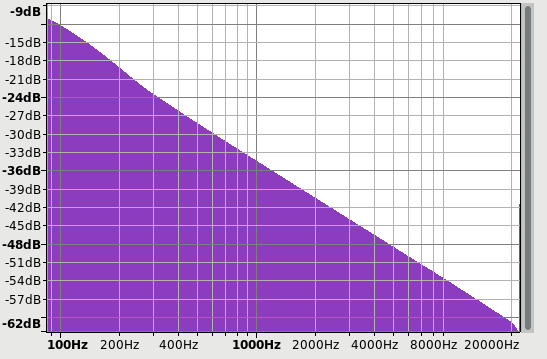
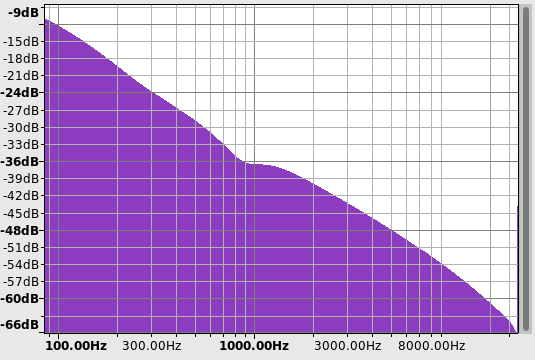
Example spectrums of input and output. Two sawtooth VCOs (tuned a third apart) are the inputs. The level knob for the high input is slightly higher volume for a brighter sound.

This “reverse crossover” brings to your rack an important characteristic of many physical instruments that even eludes most digital physical modeling systems, which is that the physics of the higher frequencies can operate according to completely different rules to the physics of the low notes.

[A customer’s beautiful build]
For example, in reed wind instruments (like the clarinet and sax), the lower frequency waves push into the first open key and do not significantly go through the rest of the tube (thus forming the note), while higher frequencies can progress down the tube. (See the Backstory for more information.)
Splice also allows simulation of brass mutes, which typically muffle sounds below 1kHz or so: feed the signal into both inputs and turn down the “low” level (or turn up the “high” level.)
Other uses: fixed all-pass filter with attenuverters, component in compressor/limiter. Noise filter for high-hat. Splice can also be used as hi-Fi active two-way crossover (see the Release Notes).
The patch he demos is Splice, fed by a Shell waveshaper (lows) and a Blip! waveshaper (highs)
Patch Ideas: using two VCOs A (to Splice Low input) and B (to Splice High input):
- Tune B to some simple ratio lower or higher than A, such as a major third. This will give inharmonic partials, which are found in tightly-strung string instruments.
- Tune B to very close to A, and feed some of A into High as well. This will give “phantom partials” which may show up as different kinds of beating, and are found in loosely-damped string instruments. Use a different waveshape for A and B,so that each harmonic beats at different depths.
- Tune B to some pitch higher than the top note to be played, turn off or moderate the KCV, and synch from A. This will give a high fixed cyclical spectrum, found in many instruments where the effect of fixed physical geometry dominate over the note’s fundamental frequency.

Audio Example:
- Elergy: Violin-ish patch, using Shell as the main tone, and a dynamic side channel of Rasp through the Splice high input, all through a digital Hi-Q EQ bank.
Physical: 5HP or 4HP wide, 50 mm deep, 16 pin power socket (10 pin can be used).
Power (Current): +12V: 30-90mA, -12V: 30-90mA, +5V NA
(TL074/72 give lower mA: 2x 49740 quad op-amps and 5534 single op-amp give higher mA.)
Status: RELEASED – IN STOCK
More Info:
- Splice: the Backstory
- Splice: Deeper In Can you see what I see?
- Splice: Theory of Operation (see crossover theory and parameters for LR6)
- Rev 0 Board and Panel
- Splice: Release Notes
- Interactive Component Placement
- Bill of Materials (this also has substitute components for a bass/baritone Splice)
- Price and Purchasing
- fricko General Buiding Guide
 Freak Out!