I was looking at a page Classic Waveshapes and Spectra about waveforms and Fourier analysis. And one of the waveshapes they showed stopped me in my tracks: it was a wave made of harmonics in the Fourier series: 1,2,3,5,8,13,21,46 etc where n = n-1 + n-2.
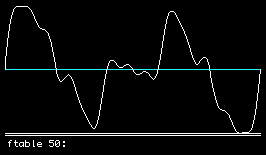
A Wave made from Harmonics of the Fibinacci Series
What stopped me was the thought: how could I approximate that waveshape using Eurorack modules? And I could not think of an arrangement that really allowed it: and it would be a bother to get there even if you could find a way. What to do?
Now, of course, it was not that I wanted to exactly make a Fibonacci series wave slavishly. What I wanted was to be able to produce the family of waveshapes like this approximation of the Fiboncci series. And it turned out that the kinds of waves it makes are more like “real” waves than the ideal/inane waves of conventional VCOs: waves where the dominant harmonic could be any of the first three or four hamonics!
So I put together a circuit design, simulated it (TINA-TI) and put it up on MuffWiggler in the public domain. The circuit divides the wave into three sections: with parameters tilt (a seesaw or the left and right section), width (the width of the middle section), and muddle (the amount of the modified input wave fed into the middle section).
Now it is available as fricko Shell. I decided to call it Shell in memory of the Fibonacci series that started the quest off.
Character of the waves
Here are examples of waves from the early simulations of the circuit, with spectra.

Examples of Possible Waveshapes and Spectra (Simulation)
Recently I built the module, and it seems to be all about the earliest harmonics: the fundamental (1) can sometimes almost disappear, and the fourth harmonic often dominates, so as a waveshaper it complements well other waveshapers, such as Blip! which is concerned with harmonics above 1 kHz, or Rasp which sweeps up harmonics. Modulating or changing the knobs allow a lot of movement of phase and of the balance between close harmonics: you can see in the examples above that the pattern of emphasizing every second or third harmonic seems a common pattern in the waveshapes.
How can we analyse these wave’s characteristics, in the abstract? From the point of view of “pulse forming” analysis, the waves can be viewed as a sequence of three waveshapes, and as a consequence you would expect three cyclic spectra to be superimposed: this seems to be reflected in the characteristic of the gaps between emphasized harmonics of two or three. Furthermore, because the wave will typically have two or three dominant maxima and minima, spaced apart, you would expect the second, third or forth harmonic to be prevelant. Furthermore, the damping width will tend to emphasize or suppress harmonics with integer numbers the same as the numerator of the pulse-width ratio: i.e. a 33% interval (i.e. 1/3) will emphasize or suppress harmonics 3, 6, 9, 12, etc. The interaction of these three mechanisms is responsible for the range of harmonics found.
Notably, the phase of some harmonics changes quite a bit with parameter changes: this effect means that the waveshapes can be modulated to get chorus/animation/thickness quite readily. The Shell module has a modulation input that affects the right-hand boundary of the middle section, akin to a pulse-wave modulation.
 Freak Out!
Leave a comment